The quick answer
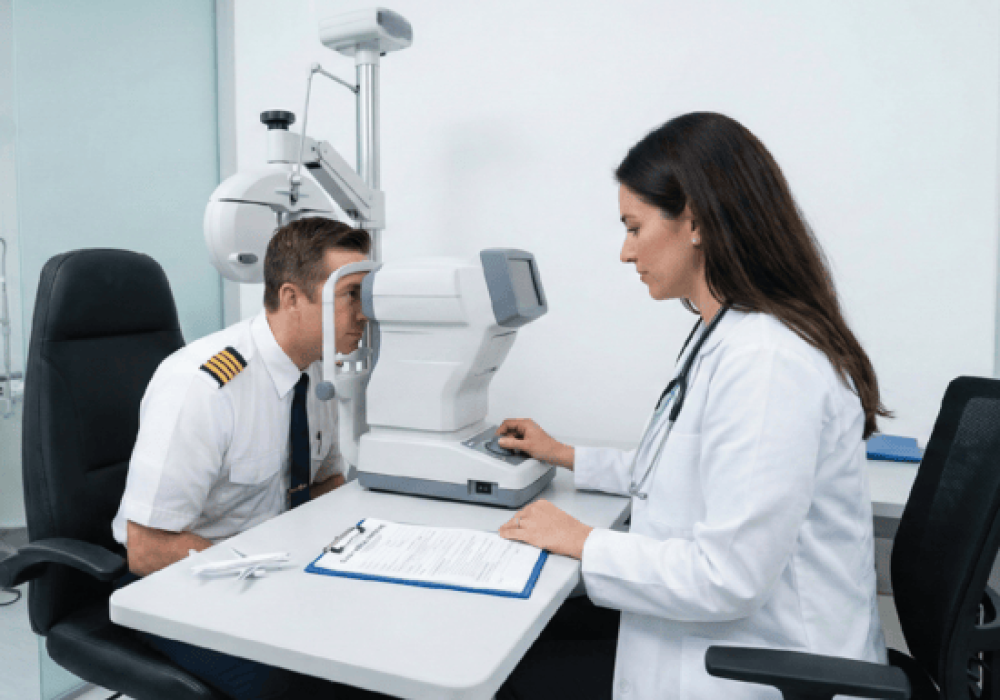
A Class 1 medical is the health clearance you must hold to exercise commercial pilot privileges in India (CPL/ATPL operations). It’s conducted under DGCA’s medical rules aligned to ICAO standards and administered at designated Indian Air Force centres and DGCA-empanelled civil facilities.
Who needs Class 1—and when
- Commercial flying (airline, charter, instruction for hire): you need a valid Class 1 medical. DGCA frames medical standards and assessments in line with ICAO; the licensing and medical pages are the primary reference.
- Students/private pilots can fly on Class 2, but must upgrade to Class 1 before exercising commercial privileges. (That’s why many cadets do Class 2 early to start training, then complete the Class 1 before CPL issue or employment.) Official medical resources: DGCA medical pages and the Class 1 centre lists.
Where Class 1 medicals are done
Initial and renewal medicals are conducted at:
- Indian Air Force centres such as AFCME (New Delhi) and IAM, IAF (Bengaluru), along with other IAF medical evaluation centres.
- DGCA-empanelled civil facilities (for specified initials and renewals). DGCA’s published lists and notices confirm empanelment and contact details.
Tip: Always check the current list before you book. DGCA posts centre lists and public notices on the main site and updates them periodically.
How to book—appointments, PMR, and eGCA
- Create/Use your eGCA login to manage pilot services and appointments.
- Centralised appointment & PMR forwarding applies when you’re booking certain IAF centres; DGCA’s own material and the official centre list describe the PMR forwarding mechanism and contact routes.
- DGCA’s Flight Crew Licensing Circular (FCL) 03 of 2025 provides general instructions for conducting Class 1 medicals—use it as your policy compass alongside the centre list.
What gets checked (big picture)
DGCA medicals follow ICAO Annex 1-aligned standards. Expect a thorough review of:
- Vision—distance, near, colour vision, corrective lenses acceptance.
- Hearing—audiometry per aviation standards.
- Cardiovascular health—history, blood pressure, ECG, and additional cardiac work-up if indicated.
- General health—labs and clinical exam; investigations vary by age, risk factors, and examiner judgement within DGCA norms.
Why it’s rigorous: the aim is not to catch you out but to verify fitness for high-workload, safety-critical environments, in sync with ICAO.
Validity and renewal
DGCA’s “Validity of medical fitness assessment” rule page states the period of validity by licence category. In practice:
- Airline/Commercial operations—medical assessment validity is 12 months.
- Student/Private licences—24 months.
Always check your assessment letter and renewal due date; DGCA publishes the validity table under the Aircraft Rules section online.
Initial vs renewal—what’s different
- Initial Class 1: a first-time, deeper assessment. It’s commonly scheduled at AFCME/IAM or other designated centres; some civil facilities are empanelled for specified Class 1 initial examinations.
- Renewal Class 1: periodic re-validation at IAF centres or with DGCA-empanelled Class 1 examiners/civil hospitals, as listed by DGCA.
Step-by-step: booking and completing your Class 1
- Collect your records—previous medicals, prescription details, glasses/contact lens data.
- eGCA account—log in and follow the medical appointment workflow.
- Choose the centre—IAF or empanelled civil facility, based on whether it’s an initial or renewal and current availability. Cross-check on DGCA’s lists/notices.
- PMR forwarding (if required)—for certain IAF bookings, request PMR forwarding as directed in the DGCA centre list note.
- Exam day—carry ID, appointment confirmation, any corrective lenses, and recent clinical reports if you have medical history.
- Assessment outcome—fit, fit with limitation, or temporary unfit with guidance on follow-up. For referred/special cases, centres like AFCME/IAM handle advanced evaluations.
Practical prep that actually helps
- Sleep and hydration—avoid caffeine overload before ECG/audiometry.
- Bring your lenses—and your optical prescription.
- Medication list—with doses; disclose honestly.
- If you’ve had recent illness or surgery, carry discharge summaries and test reports; it saves weeks of back-and-forth.
Bottom line
Think of Class 1 as your professional health clearance—routine for most, detailed where needed, and entirely transparent if you stick to DGCA’s own pages, lists, and circulars. Book through eGCA, confirm the correct centre, follow PMR instructions where applicable, and keep your documents tidy. Do that and the medical becomes a predictable checkpoint rather than a mystery.
Common questions
Is Class 1 mandatory for CPL issue or only for flying the line?
You must hold Class 1 to exercise commercial privileges. Many cadets clear it before licence issue or joining, to avoid delays. DGCA anchors medical standards and assessments on its medical pages and circulars.
Where can I see official centres and contacts?
On DGCA medical pages—IAF centres and DGCA-empanelled civil facilities are listed with addresses or contact points, and public notices reflect fresh empanelments.
How long is my Class 1 valid?
DGCA’s validity page shows 12 months for commercial and 24 months for student/private. Always follow the date printed on your medical assessment.
What if I’m declared ‘temporary unfit’?
You’ll receive instructions for review or additional tests. Certain referred cases are assessed at AFCME/IAM or other IAF medical evaluation centres, per DGCA practice.
Disclaimer:
This article is intended for informational purposes only and does not constitute legal or regulatory advice. While every effort has been made to ensure accuracy, applicants are advised to refer to the official DGCA Pariksha portal and consult authorized professionals or aviation training institutions for guidance tailored to their specific cases. Wing Path and the authors are not responsible for any outcomes resulting from misinterpretation or misapplication of the information provided.